
Double Click: Target Corp. Q3 2025 Earnings Review & Commentary
Comps down - 2.7%. Operating income down -18.9%. Will spend an additional $ 1 billion on capex in 2026 to improve stores, add technology. Wants to get back to being a design-led company.

I listened to the Target Corp (NYSE: TGT) Q3 2025 earnings call on November 19th. The call was hosted by Brian Cornell (Chair & Outgoing CEO), Michael Fiddelke (Incoming CEO & EVP COO), Rick Gomez (EVP & CCO) & Jim Lee (EVP & CFO).
GAAP Financials (all in $ USD)
Q3 net sales were $ 25.3 billion, down -1.5%. Merchandise sales were down - 1.9% while non-merchandise sales were up + 17.7%. Transaction were down -2.2% while average basket was down - 5%.
Q3 comps were down - 2.7%, with store comps down - 3.8% while digital comps were up + 2.4%. August & October were flat while September was down about - 4%. The retailer saw weakness in home & apparel, while food, beverage & hardlines (now Fun 101) saw growth. The retailer claims they saw strong sales in “seasonal moments” including back-to-school, back-to-college & Halloween.
Target Digital saw a + 35% increase in same-day delivery. Target 360, the companies paid membership program, saw growth as well. Target+, its 3rd party marketplace enjoyed a gross merchandise volume (GMV) increase of + 50% in the quarter.
The retailer’s Target Circle card saw lower spend and lower penetration in Q3.
Target Roundel, the retailers internal media company produced “mid-teens” growth in revenue in Q3, coming in at $ 241 million.
Gross margin rate was 28.2% in Q3, down - 10bps. The retailer had a 1% headwind due to increased markdowns but saw a reduction in shrink vs. last year that provided a tailwind of about + 70 bps. Target also had a + 20 bps tailwind with lower supply chain & digital fulfillment costs due to productivity gains & the comping of a supply chain issue last year.
SG & A was $ 5.54 billion or 21.9% of sales in Q3, up + 1.4% or + 60bps to last year due to one-time business transformation costs.
Q3 operating income was $ 948 million, down -18.9 % from last year. This represented 3.8% of net sales vs. 4.6% last year.
Third quarter effective tax rate was 19.8%, down from 21.7% last year due to additional tax credits.
Net earnings were $ 689 million, down - 19.3 % from last year. This represented 2.7% of net sales vs. 3.3% last year.
EPS was $ 1.51 for the quarter, down from $ 1.85 last year.
The company distributed a $ 518 million dividend in Q3, up + 1.8% from last year & repurchased $ 150 million in shares.
Target had $ 3.82 billion of cash & cash equivalents on hand at the end of Q3, up + 11.4% over last year.
Cash provided by operating activities was $ 3.49 billion, down - 14.5 %.
Year-to-date capital expense (capex) was $ 2.8 billion.
Q3 ending inventory was $ 14.9 billion, down - 2% vs. last year. Management indicated they were happy with the quality of the inventory as high frequency items have increased as a % of stock while discretionary items are a lower %.
Trailing 12 month after-tax return on invested capital (ROIC) was 13.4% vs 15.9% last year.
Target operated 1,995 stores at the end of Q3, up from 1,978 stores at the end of Q3/24.
Management Commentary
As outgoing CEO, Cornell opened the call and reviewed Target’s accomplishments over the last 10 years but also acknowledged that recently the company has not performed as well as it could have, and signed off on his final earnings call.
As incoming CEO, Fiddelke took the call over & indicated that Target has “high but achievable aspirations”. He said that the company is not satisfied with results & outlined 3 priorities for Target to transition to long term sustainable profitable growth over time.
Solidify design led merchandising authority.
Provide a more consistently elevated shopping experience across stores & digital platforms.
More fully use technology to improve speed, efficiency & guest experience throughout the business.
These 3 priorities are in service if one goal: getting back to sustainable growth as soon as possible.
Fiddelke discussed Target’s recent restructuring. The company downsized by 1,800 headquarters staff, or 8% of its HQ workforce to remove layers while increasing agility, speed and accountability. The incoming CEO said it was not about cost but I think realistically it was about cost as the retailer needed to lower SG & A expense as sales declined.
Merchandising Authority
Target wants to be a design led company that has a unique ability to produce on-trend products that are great value. This enables the retailer to be differentiated in the market. It involves creating a distinct assortment in key categories. Management indicated that the guest responds well, when seeing newness and style-forward products.
An example of this is the hardline division, now referred to as Fun 101. This is about staying close to the guest & predicting or setting new trends to build confidence with customers.
From a technology perspective, this means leveraging AI enabled customer insights which drive design & speed to market capabilities. Having real-time access to insights from social media trends, that allows team members to predict emerging designs.
The company has what it calls a “Target Trend Brain” tool, using generative AI that identifies & predicts future trends faster. The retailer is also using “synthetic audiences” to simulate user groups to preview & test products, marketing campaigns & messaging before launch.
Target is also redefining roles within its “merchant roundtable” structure to enable bolder decisions faster. The retailer is automating additional components of its merchandising decision making process whereby team members spend less time on analysis & more time being creative.
The retailer has new leadership within its home business.
Its contract with Ulta Beauty ends in August of 2026 & the team is currently working on a replacement concept.
Baby is another category where Target sees opportunities, particularly as a customer acquisition on-ramp. The category will be more inviting & inspirational in store with gifting being enhanced.
Overall, Target is using updated people, process & technology to drive newness & differentiation.
Elevate Guest Shopping Experience (Store & Digital)
Target wants to create a warm & friendly team atmosphere by using technology to make back room tasks more efficient, thus freeing up time to assist guests. Tasks such as truck unloading & finding products will be completed quicker.
The retailer has launched a gift finder within its app using generative AI.
Target sees opportunity to revitalize its Target Circle card, one of the biggest cards in the country. Management wants to increase upsell to the Target Circle 360 membership program which will have more early access events in 2026.
Another key component to this priority is improving in-stock position. The company has invested to ensure the right product is at the right location at the right time all year long. Target is modernizing technology to optimize forecasting & replenishment using machine learning to manage flow from supplier to shelf to move inventory more efficiently.
The team has improved process through root cause analysis & clearer measurements. Target said these efforts have improved in-stock position by + 150 bps over the last year on its top 5,000 skus - which represent 30% of its unit sales volume. The retailer admits that there is more room for improvement though.
From an omni-channel retailing perspective, Target has been testing a new fulfillment approach for online orders in Chicago. Stores that have high foot traffic will fulfill less of the markets “brown box” or online orders. Stores that have lower foot traffic and larger backrooms will fulfill more of the markets online orders. Labor hours will be adjusted accordingly. The test has resulted in improved delivery speed to guests & lower fulfillment costs.
At this point, 80% of the US population can receive same-day delivery using Target Circle 360 - which is up + 35% in Q3. Also, 99% of the US population is eligible for 2 day shipping at this time. Target is working to expand next-day shipping to half of the US population in the future.
The company has partnered with OpenAI to offer “conversational curation” to increase digital engagement. With this arrangement, Target guests can purchase multiple items in a single transaction including fresh food. The app offers both drive up & pick up options.
The retailer is also investing in new stores & existing store remodels. Target discussed the success of its new larger format stores as “out pacing expectations” and being a strong source of growth. Stores will improve discovery, inspiration & better showcase new product style & design. Management indicated that in 2026, stores will see “more change to the floor than in the last 10 years”.
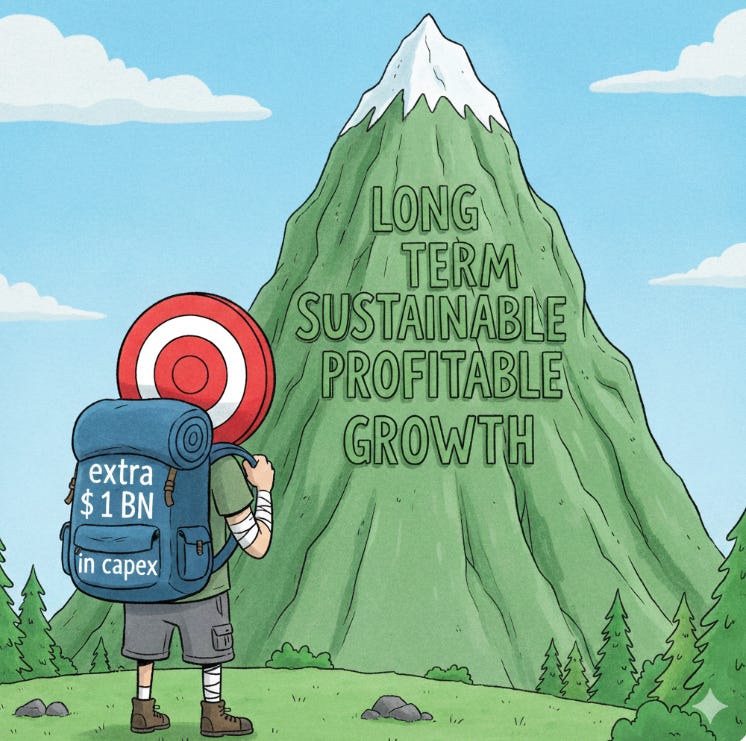
In 2026, the company will make major change to its “floor pad” & will spend an incremental $ 1 billion in capital (capex), a 25% increase from 2024 to fund the changes noted above.
Merchandising
Gomez discussed Target’s activity within merchandising. He indicated that the retailer is tying to improve performance within discretionary categories while building agility.
Gomez used Fun 101 as an example of a new blueprint for success. In Q3, toys were up + 10% from a comp store sales perspective. Target also saw double digit increases in music, video games & sporting equipment. Overall, Fun 101 continued growing in Q3 but at about a - 60 bps lower rate due to the strength from the Nintendo Switch2 in Q2.
Beverage was up almost + 7% based on success of health & wellness drinks. Candy sold well also.
Apparel saw comp store sales down about - 5% but denim & sleepwear were up. Going forward, the company hopes to drive sales in the women’s apparel category through “lux fabrics & trending athleisure at affordable prices”.
Gomez indicated that the retailer is selling “twice the volume of new products as the industry”.
The retailer discussed sweaters at $ 30, holiday decor starting at $1, $ 3 & $ 5, new trading cards dropping almost every week & thousands of toys under $ 20. In fact, Target claims they have 20,000 new items in this years holiday assortment, about half exclusive to the chain and double the number of new items from last year.
Consumer
Target described the current state of the consumer as choiceful, prioritizing value, & stretching budgets. The retailer said that guests are looking for essentials in food & beauty & are open to trend-right deals in discretionary categories. Customers are cautious as consumer sentiment is at its lowest in 3 years due to fear of job loss, affordability & the impact of tariffs.
The retailer recently lowered prices on 3,000 items and is offering a Thanksgiving meal deal that feeds a family of 4 for under $ 20. Target’s Good & Gather turkey is .79 cents per lbs.
Management Guidance
For Q4/25, Target sees significant volatility in its sales based on the state of the customer. However, the company is maintaining its previous top-line forecast of a low-single digit decline in sales.
For 2025 full year, the retailer has narrowed its forecast for EPS to within $ 7.70 to $ 8.70 per share.
For full year 2025, Target has forecasted a +80bps to +90 bps tailwind to margins due to lower shrink levels - which are now back down to pre-pandemic levels.
Full year capex is expected to be $ 4 billion.
2026
As mentioned above, Target is increasing its capital expenditure budget by + 25% to $ 5 billion to fund the changes to the business mentioned above. The company also forecasts a $ 180 million annual savings to SG & A due to the business transformation activities listed above.
The company assured analysts that they should not expect changes to the annual dividend in 2026.
Target will be hosting the financial community on March 3, 2026 in Minneapolis.
Share Price Dynamics
Target’s share price closed on November 18th at $ 88.77. On November 19th (after Q3 earnings were released) the stock opened at $ 88.48, just slightly down. On the day of writing this note on November 23rd, the stock has dropped - 2.4% over the last 5 trading days. TGT is down - 6.3% over the last month, down - 29.9 % over the last year & down - 49.2% over the last 5 years.
My Commentary
Target is a work-in-progress. They had a fairly tough Q3, particularly from an operating & net income perspective.
But it appears like the management team has started several initiatives which could improve guest sentiment and hopefully financials over time. The extra $ 1 billion in capex in 2026 should help them execute on new strategies & tactics in store and online, despite the negative short-term impact on free cash flow.
Target received significant backlash from their newly implemented 10-4 policy for associates (if a shopper comes within 10 feet, smile, wave. If 4 feet, ask them if they need help or how their day is going), but don’t count them out yet.
My biggest concern with Target is whether they can bring customers back who may have started shopping at competitors and if enough customers are willing or able to pay a little more for Target’s style & design superiority, once it is reestablished.
What do you think?
Thanks for reading!
Bruce Winder
Retail Analyst
Bruce Winder Retail - BWR
416-705-5627 - bwinder@brucewinder.com
NOTE: The comments above are my own personal opinion and do not represent investment advice. See a professional investment advisor.
This article comes at the perfect time. What if Target's digital growth is more than seasonal, a fundamental shift they should realy embrace?